
19 Nov 2017
How Soviet Artists Imagined Communist Life in Space
Artists from the Soviet Union didn't just imagine a worker's Utopia on Earth. They also thought that the great communist experiment would eventually reach other worlds, too. Here are some incredible works of art and conceptual design that put the Soviet Union in space.


Testicular cancer: 5 things every man needs to know

Here are five things every man needs to know:
Testicular cancer is very curable. While a cancer diagnosis is always serious, the good news about testicular cancer is that it is treated successfully in 95 percent of cases. If treated early, that number rises to 98 percent. Although a man’s risk of getting it is 1 in 263, his chance of dying from the disease is only about 1 in 5,000.
Early detection is especially important. Say you have a stage 1 seminoma — a tumor that grows slowly and stays within the testicle — our standard management is observing it with serial exams, blood work, chest X-rays and CT scans. The likelihood of a cure in this circumstance? Virtually 100 percent. Even metastatic testicular cancer is highly curable, typically with a combination of chemotherapy and surgery.
18 Nov 2017
5 interesting facts about the human body

1. For every pound of fat gained, you add seven miles of new blood vessels.
New tissue needs blood supply, so your vascular system expands to accommodate it. This also means your heart must work harder to pump blood through the new network, which may reduce oxygenation and nutrient replenishment in other tissues. Lose a pound? Your body will break down and reabsorb the unneeded blood vessels from the previous tissue.
2. You are taller in the morning than in the evening.
Temple of Artemis, Sardis

Just outside the entrance was an altar of Artemis much older than the temple, from as early as the 6th century BC. In the Hellenistic period the altar was incorporated into a large stepped platform that still exists.
Immortality is impossible, say scientists studying the mathematics of aging
 While healthcare has dramatically extended our lifespans by preventing certain causes of death, aging still inevitably takes its fatal toll. And, as scientists report in a new Proceedings of the National Academy of Sciences study, that’s not going to change: Whether it’s by cancer or run-of-the-mill cell destruction, aging and death is mathematically inescapable.
In the paper published Monday, Joanna Masel, Ph.D., and Paul Nelson, Ph.D., both of the Department of Ecology and Evolutionary Biology at the University of Arizona, provide mathematical evidence that aging and eventual death must happen, no matter how we intervene in the aging process.
They explain that every cell in the body is tasked with two opposing missions: ensuring its own survival and supporting the organism it’s a part of. Masel and Nelson reason that this endless push and pull between those missions means that aging is unstoppable.
30 Oct 2017
The lightest robot. A biologically inspired microrobot.
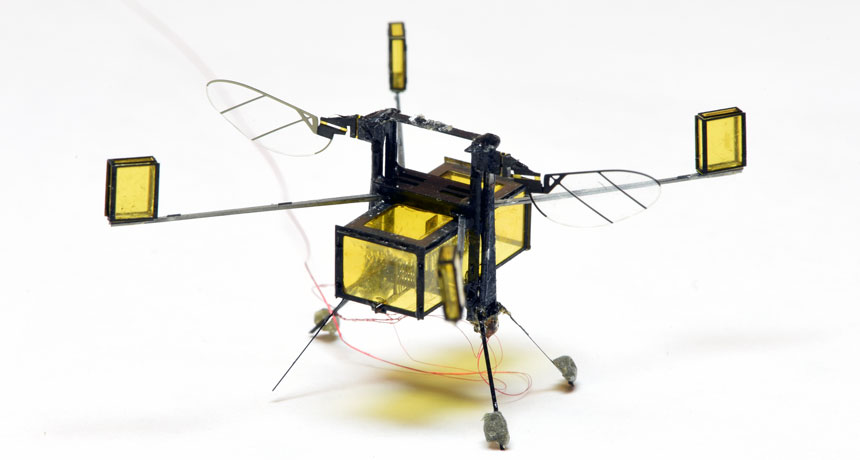
The insect-inspired machine is about 1,000 times lighter than previous aerial-aquatic bots. The new robot that can move between air and water is a lightweight.
Weighing the same as about six grains of rice, it is the lightest robot that can fly, swim and launch itself from water, an international team of researchers reports October 25 in Science Robotics. The bot is about 1,000 times lighter than other previously developed aerial-aquatic robots. In the future, this kind of aquatic flier could be used to perform search-and-rescue operations, sample water quality or simply explore by air or sea.
Subscribe to:
Posts (Atom)
